



Table of Contents
On June 12, Order ECM/599/2025 was published in the Official State Gazette (BOE), a key regulation for the real estate and financial sectors that introduces a significant change: electronic signatures are now mandatory for all appraisal reports prepared for financial purposes. This new requirement, which takes effect on August 12, 2025, strengthens the integrity, traceability, and legal reliability of appraisal documents.
What does the new Order regulate?
Order ECM/599/2025 amends the well-known Order ECO/805/2003, establishing valuation rules for real estate and certain real rights. These reports are essential when used as:
- Mortgage guarantee on credits and loans.
- Basis for determining the fair value of insurance and reinsurance assets.
- Reference for calculating the net worth of pension funds or collective real estate investments.
With this amendment, appraisal reports must have a clearer structure, include sustainability elements, and, above all, ensure that all professionals involved in their preparation provide a mandatory electronic signature.
| Key Fact | Details |
|---|---|
| Published Regulation | Order ECM/599/2025 (Official State Gazette, June 12, 2025) |
| Regulation amending | Order ECO/805/2003 (regulations on the valuation of real estate) |
| Effective Date | August 12, 2025 |
| Primary Requirement | Electronic signatures are required on all appraisal reports prepared for financial purposes |
| Required Signature Type | Qualified or advanced electronic signature (depending on the signer’s profile) |
| Regulated Entities | Appraisers, technical reviewers, final validators, and appraisal firms |
| Scope of Application | Appraisals used as mortgage collateral, valuation of assets held by insurance companies and pension/investment funds |
Obligated parties: who must sign electronically?
The regulation requires that all professionals and entities involved in the preparation, review, and validation of the appraisal report sign it using a qualified or advanced electronic signature. This applies to both:
- Individuals: individual appraisers, technical architects, quantity surveyors, etc.
- Legal entities: appraisal companies, collaborating entities and financial entities with appraisal capacity.
| Signatory Profile | Role in the process | Recommended signature type | Note |
|---|---|---|---|
| Appraiser and Reporter | Prepares and signs the main report | Qualified electronic signature (QES) | Highest level of legal assurance — equivalent to a handwritten signature under eIDAS |
| Technical Reviewer | Verifies the report’s compliance with regulations | Qualified or advanced electronic signature (QES) | Depends on the level of responsibility assumed in the process |
| Validator / Technical Lead | Approves and definitively validates the report | Qualified Electronic Signature (QES) | When assuming final responsibility, a qualified signature is recommended |
| Appraisal firm (legal entity) | Institutional signature on the document | Qualified electronic seal | For legal entities, the equivalent of a qualified signature is a qualified electronic seal |
How is an appraisal report prepared and who must sign it?
The process of preparing a real estate appraisal report is rigorous and structured. This document is the basis for many financial decisions, so its development involves different professional profiles, all of them now obliged to sign electronically.
Usual flow in the preparation of the appraisal report:
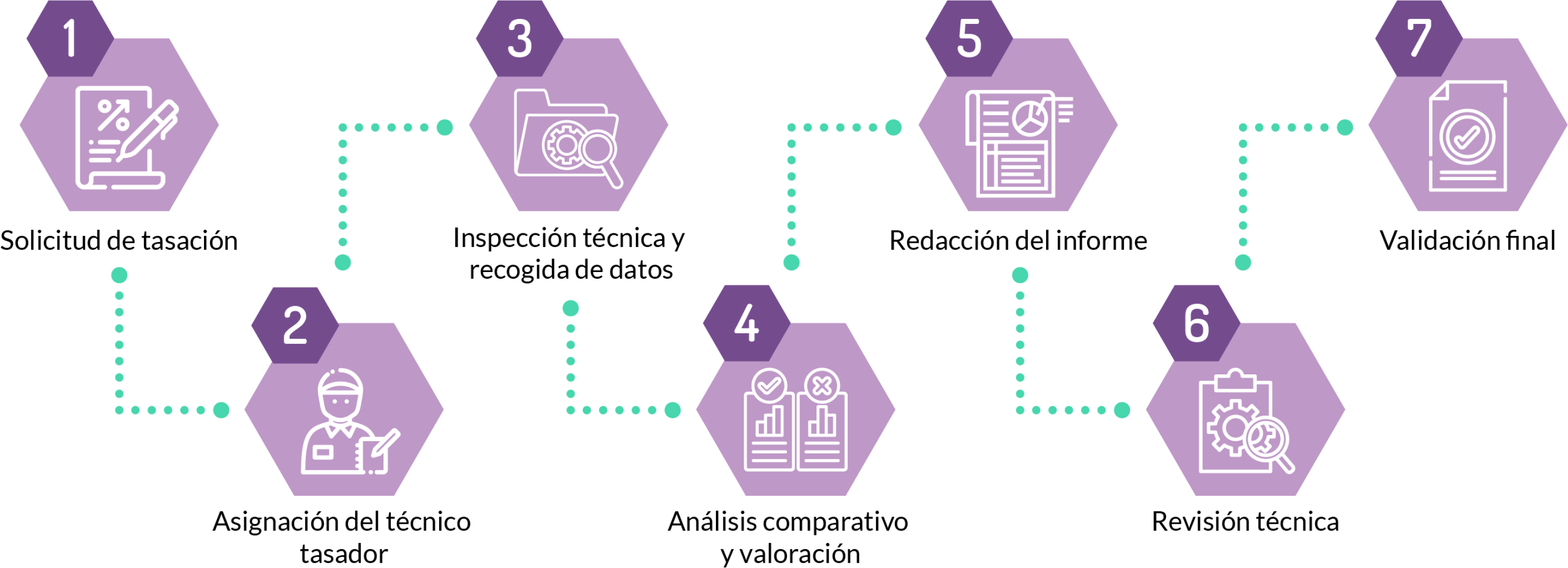
- Appraisal request
A client (financial institution, insurance company, developer, individual…) requests an appraisal from an approved appraisal company. - Appointment of the Appraiser
The company appoints a qualified professional (architect, technical architect, engineer, etc.) to inspect and appraise the property. - Technical inspection and data collection
The technician conducts an on-site visit to the property, takes measurements, reviews the registry and cadastral documentation, and assesses the surrounding area. - Comparative Analysis and Valuation
Recognized valuation methods (comparable sales, cost, income capitalization, residual, etc.) are applied, depending on the type of property and its intended use. - Preparation of the Report
The appraiser prepares the report in accordance with the technical and legal criteria established in Order ECO/805/2003, including appendices and plans. - Technical review
A second professional from the appraisal company (usually a reviewer or supervisor) verifies that the report complies with the regulations. - Final approval
A third party—often a technical expert appointed by the appraisal firm—gives the final approval of the document.
Who must electronically sign the report?
With the entry into force of Order ECM/599/2025, all professionals substantively involved in the document must sign it electronically. These are usually:
- The appraiser who prepared the report.
- The technical reviewer.
- The validator or the appraisal firm’s chief technical officer.
In many cases, the final report may take up to three electronic signatures, implying the need for a clear, agile and legally robust signature flow.
Automate the lifecycle of your commercial agreements and drastically reduce the time it takes to finalize them by implementing a comprehensive platform that unifies identity verification, consent, and deal closing through electronic contracting.
Why is the electronic signature so relevant?
A qualified electronic signature is the highest level recognized by the eIDAS Regulation: it has full legal equivalence to a handwritten signature throughout the EU and creates a presumption of the integrity of the document and the identity of the signatory without the need for a prior agreement between the parties.
The regulations require documents to be electronically signed in a manner that ensures:
- Authenticity: It is possible to verify who signed it.
- Integrity: The content cannot be modified after signing.
- Traceability: A certified digital record of the process is maintained.
In addition, appraisal companies are required to implement technical procedures to ensure that documents are not altered once signed and that they can be retained with legal guarantees. This raises the technical requirements and makes electronic signatures with certified custody an indispensable solution.
Ensure the legal validity of your documents and transactions in the event of any future litigation by entrusting your critical workflows to a technology partner backed by Mailteck and Customer Comms, both of which are certified by the Ministry for the preservation of electronic signatures and seals.
| Type of electronic signature | eIDAS Level | Legal validity | Technical requirement | When to Use in Tax Assessments |
|---|---|---|---|---|
| Simple electronic signature | Basic Level | Limited — no automatic presumption | Only identifies the signer (e.g., clicking “I accept”) | Not recommended for appraisal reports for financial purposes |
| Advanced Electronic Signature (AES) | Intermediate level | High — uniquely links the signer and detects tampering | Personal digital certificate or advanced biometrics | Valid for reviewers with secondary responsibility |
| Qualified Electronic Signature (FEQ) | Highest Level | Maximum — equivalent to a handwritten signature throughout the EU under eIDAS | Qualified certificate issued by a supervised PSCC | Recommended for appraisers, drafters, and final validators |

How can we help you?
For an appraisal firm that produces a high volume of monthly reports, the signing workflow can involve up to three signatories per document, with tight deadlines and the need for long-term certified storage. Our platform automates this workflow: the report is sent sequentially to the appraiser, reviewer, and validator via their preferred channel (email, SMS, or WhatsApp), each signature is recorded with a timestamp, and the final document is stored with a guarantee of tamper-proof integrity in accordance with eIDAS and the requirements of Order ECM/599/2025.
We are qualified, trusted service providers specializing in certified electronic delivery, which allows us to offer you solutions that not only comply with the law but also make implementation as easy as possible. Our multi-channel electronic signature platform allows you to:
✅ Sign appraisal reports from any device, without software installation.
✅ Send signature requests through multiple channels: Email, SMS, WhatsApp, RCS (Rich Communication Services).
✅ Certified custody of the signed document, guaranteeing that the content has not been modified, even years after its issuance.
✅ Easy integration with the internal flows of appraisal companies and financial institutions.
✅ Full compliance with the eIDAS Regulation and the technical and legal requirements of Order ECM/599/2025.
Ensure maximum legal protection for your business agreements and client contracts by using robust, traceable digital evidence—which is only available through an advanced electronic signature solution.
Conclusion
The entry into force of this regulation marks a milestone in the digitization of the real estate valuation industry. Although it implies new obligations, it also represents a great opportunity to optimize processes, improve customer experience and ensure regulatory compliance.
If you are an appraisal company, industry professional or financial institution, having an agile, legally robust and multichannel electronic signature solution is the easiest way to comply with this new regulation without friction.
Frequently Asked Questions
What is Order ECM/599/2025, and who does it affect?
Order ECM/599/2025, published in the Official State Gazette (BOE) on June 12, 2025, amends Order ECO/805/2003 on real estate appraisal standards. It requires that all appraisal reports for financial purposes—used as mortgage collateral, for the valuation of insurance company assets, or as a reference for pension funds—include a qualified or advanced electronic signature from all professionals involved. This applies to individual appraisers, technical reviewers, validators, and accredited appraisal firms.
What type of electronic signature do appraisal regulations require?
Order ECM/599/2025 requires an electronic signature as defined by the eIDAS Regulation. To ensure maximum legal certainty, a qualified electronic signature (FEQ) is recommended for the appraiser drafting the report and the final validator, as it is fully equivalent to a handwritten signature throughout the EU. An advanced electronic signature (FEA) may be sufficient for technical reviewers, depending on the level of responsibility assumed. Confirm this with the interpretation of the Order provided by the Bank of Spain or the relevant supervisory authority.
How many signatures can an appraisal report have?
A valuation report may require up to three electronic signatures: that of the appraiser who drafted it, that of the technical reviewer, and that of the validator or the final technical officer at the valuation firm. Depending on the size and structure of the firm, some of these roles may be held by the same person. What is important is that all individuals who play a substantive role in the preparation, review, and validation of the report electronically sign the final document.
How should an electronically signed appraisal report be safeguarded?
Order ECM/599/2025 requires appraisal firms to implement procedures that ensure signed documents are not altered and can be retained in a manner that meets legal requirements. This involves certified storage of the signed document with a qualified time stamp, which verifies the integrity of the content at any subsequent point in time. Given the retention periods in the mortgage sector (up to 30 years), an eIDAS-compliant custody solution with the option for periodic resealing is recommended.
What happens if an appraisal report does not have an electronic signature after August 12, 2025?
A valuation report that does not comply with the electronic signature requirements of Order ECM/599/2025 may not be accepted by financial institutions as valid mortgage collateral, nor by insurance companies or pension funds for their asset valuations. Furthermore, the appraisal firm may be in violation of the valuation regulations supervised by the Bank of Spain, with the corresponding administrative consequences.