


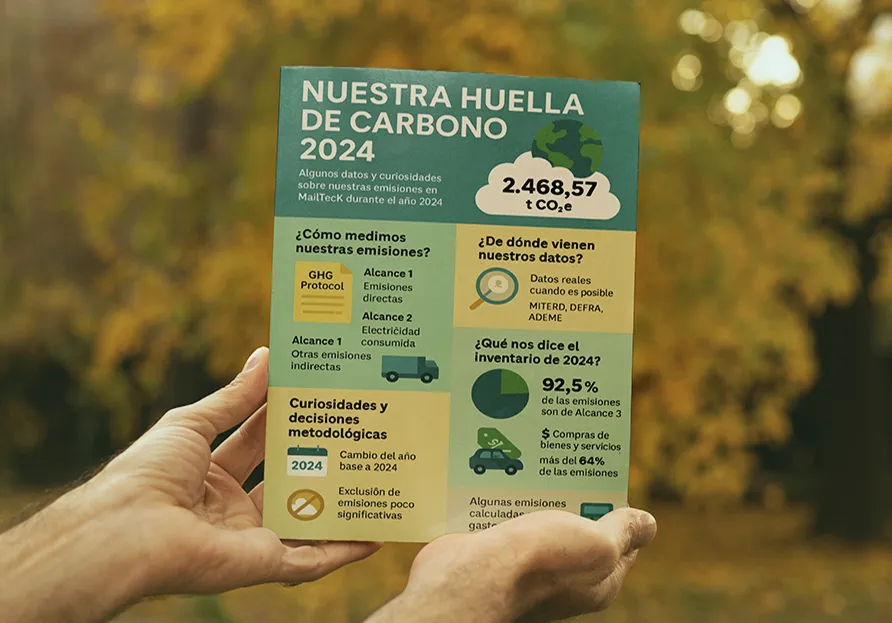
Once again this year, we have analyzed our carbon footprint in order to understand, manage and reduce the impact that our activities have on climate change. This report reflects our commitment to truthfulness and transparency.
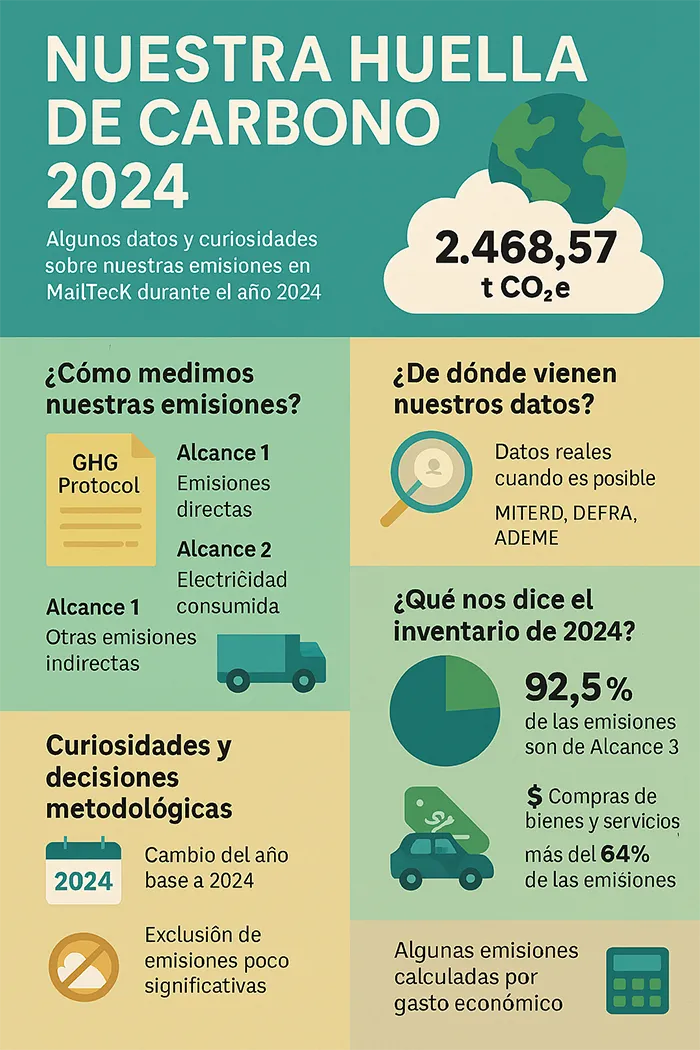
And the result was: 2,468.57 t CO2e, we explain how it is measured and what it means.
📏 How are emissions measured?
We use the international standard GHG Protocol, which divides emissions into three major groups called “scopes”:
- Scope 1: Direct emissions, such as fuel from our vehicles or refrigerant leaks (air conditioning recharges).
- Scope 2: Indirect emissions from the purchase of electricity.
- Scope 3: Broader indirect emissions, such as those from the products we buy, employee commuting, transportation of goods, and waste treatment. Scope 3 has several categories, some of which are complex to calculate. This is where we have made every effort to calculate them for the period 2024.
🔍 Where does our data come from?
We prioritize direct data whenever possible: electricity bills, liters of fuel refueled, kilometers traveled, tons of paper purchased… When there is no direct data, we use estimates based on economic expenses or data capture from internal surveys, such as the Commuting to Work Survey that you receive annually.
Emission factors (how much CO₂ each activity generates) come from official sources such as the Ministry for Ecological Transition (MITERD), and other international sources.
Here’s the scoop!: WebToPrint for businesses: how to outsource mail management with sustainability, efficiency, and certified traceability.
📊 What does our 2024 emissions data say?
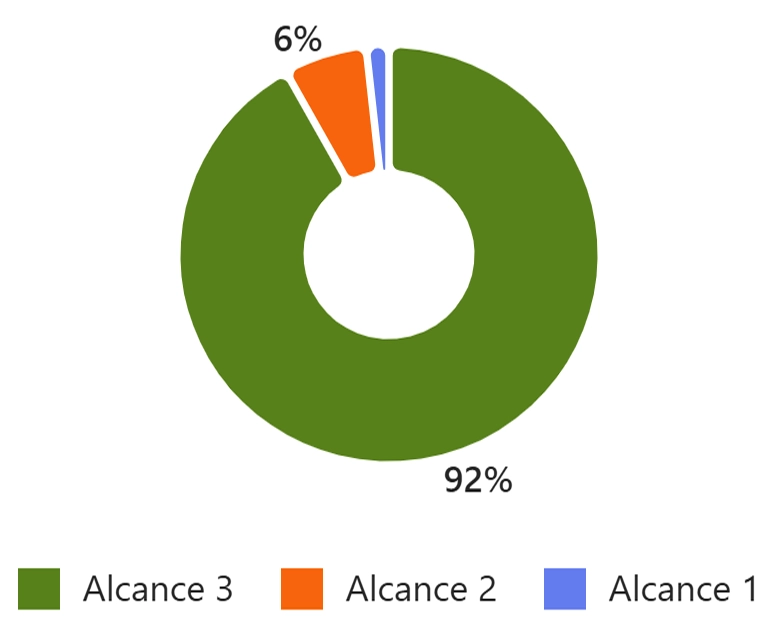
- 92.5% of our emissions come from Scope 3, which reflects that the greatest impact is in indirect activities over which we have less control than direct ones. This is the case of emissions produced by our suppliers.
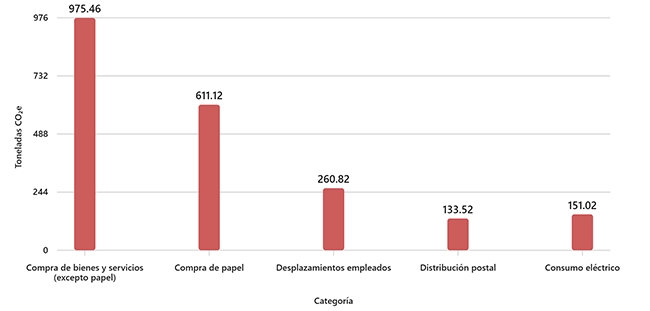
- Within this scope 3, purchases of goods and services (including paper) represent more than 64% of our emissions.
- Employee commuting generates 260.82 tCO₂e, equivalent to 10.57% of the total. They also belong to Scope 3.
- Electricity consumption (Scope 2) represents only 6.12%, thanks to the majority purchase of green energy in 2024.
- This means that our direct emissions are not high and we will be able to reduce or offset them, but we will have to require our suppliers in the supply chain to make commensurate efforts to reduce their emissions.
Check out our post: Sustainable Paper Sourcing: FSC and PEFC Certifications, Recycled Paper, and MailComms Group’s 86% Commitment.
| GHG Protocol Scope | Main Category | t CO2e 2024 | % of total |
|---|---|---|---|
| Scope 1 — Direct Emissions | Vehicle fuel + refrigerant leaks | Data to be confirmed with A.J. Díaz Mora | ~1.4% |
| Scope 2 — Electricity | Electricity consumption (mostly green energy) | ~151 metric tons of CO2e (est.) | 6.12% |
| Scope 3 — Indirect | Purchases of goods and services (including paper) | >1,580 metric tons of CO2e (estimated at 64%+ of the total) | 64%+ |
| Scope 3 — Indirect | Employee Travel | 260.82 metric tons of CO2e | 10.57% |
| Scope 3 — Indirect | Other Scope 3 Categories | Data to be confirmed | ~16.8% |
| TOTAL | Scopes 1 + 2 + 3 | 2,468.57 metric tons of CO2e | 100% |
🚀 What now?
We have changed the base year to 2024, as we have expanded the categories measured in Scope 3, which makes the data not comparable with previous years. The advantage is that, from this year onwards, the results will be comparable with each other, as we will maintain the reported categories over time.
This report not only helps us to meet our environmental commitments, but also allows us to identify opportunities for improvement. For example, choosing paper suppliers with a smaller product footprint, or that are closer to our plant.
All companies are called upon to reduce their carbon footprint by 2050 in order to minimize climate change.
Starting in 2024, our 2025–2030 Sustainability Plan sets annual emission reduction targets by scope. The priority reduction levers are: (1) selecting paper suppliers with a lower product footprint and greater geographic proximity, which directly impacts over 64% of Scope 3; (2) promoting sustainable transportation for employees, with the goal of reducing the 260.82 metric tons of CO2e from commuting; and (3) maintaining the percentage of green energy contracted to keep Scope 2 emissions low. The base year of 2024 will allow us to measure progress in a comparable way in the coming years.
Find out!: All of our certifications.
Frequently Asked Questions
What is the GHG Protocol standard, and why is it used to measure a carbon footprint?
The GHG Protocol (Greenhouse Gas Protocol) is the most widely used international standard for measuring and reporting organizations’ greenhouse gas emissions. It was developed by the World Resources Institute (WRI) and the World Business Council for Sustainable Development (WBCSD). It categorizes emissions into three scopes based on their source: Scope 1 (direct emissions from the organization), Scope 2 (indirect emissions from energy use), and Scope 3 (indirect emissions in the value chain). It is the benchmark standard for ESG reporting and corporate carbon reduction commitments.
What does it mean that 92.5% of MailComms' emissions are Scope 3?
This means that the vast majority of MailComms Group’s carbon footprint does not come from its direct activities (vehicles, facilities) but from its value chain: primarily from the goods and services it purchases—including paper—and from its employees’ commutes. This is common among service companies: their direct emissions are relatively low, but the impact of their suppliers and their employees’ travel is significant. To truly reduce Scope 3 emissions, it is necessary to work with suppliers and measure their product’s carbon footprint.
What are Scopes 1, 2, and 3 of the GHG Protocol?
Scope 1 consists of the organization’s direct emissions: fuel used by its own vehicles, refrigerant leaks, and combustion at its own facilities. Scope 2 consists of indirect emissions from purchased energy: electricity and heat. Scope 3 includes all other indirect emissions in the value chain: material purchases, freight transportation, employee commuting, use of products sold, and treatment of generated waste. Scope 3 is the most complex to calculate but is often the one with the greatest impact.
How does working with MailComms Group help reduce my own carbon footprint?
By outsourcing the management of physical communications through WebToPrint (PostaMail), companies eliminate their own printing infrastructure—equipment, supplies, and electronic waste—transferring those emissions to MailComms’ Scope 3, which manages them using FSC/PEFC-certified paper and optimized printing processes. Furthermore, replacing unnecessary physical communications with certified digital channels (certified email, SMS, WhatsApp) directly reduces the client’s document-related carbon footprint. MailComms Group can provide data on emissions avoided per project so that the client can include it in its own ESG reporting.
Does MailComms Group have an emissions reduction target?
Yes. MailComms Group’s 2025–2030 Sustainability Plan designates 2024 as the base year for measuring progress toward reducing emissions. Having completed the full Scope 3 inventory—the most complex categories—in 2024, the company can now set comparable and verifiable annual targets. MailComms Group is also a member of the SME Climate Hub, the UN’s climate commitment program for small and medium-sized enterprises.