


At MailComms Group, we have published our 2025 Sustainability Report, prepared in accordance with the requirements of ISO 14001:2015 and aligned with ESG (environmental, social and governance) principles and the United Nations Sustainable Development Goals (SDGs).
Although our company does not report under the CSDR standard, we are committed to producing a transparent and comparative annual report, which responds to the growing expectations of customers, regulators and investors in terms of sustainability.
2024 vs 2025: what has changed and why it is relevant to our customers
In 2025 we consolidate the progress made in 2024 and take very clear steps in the three ESG dimensions, with a direct impact on the sustainability of the communications we manage for our clients in banking, insurance, utilities and the Third Sector.
E for Environmental: less emissions, more circularity
100% renewable energy and higher efficiency
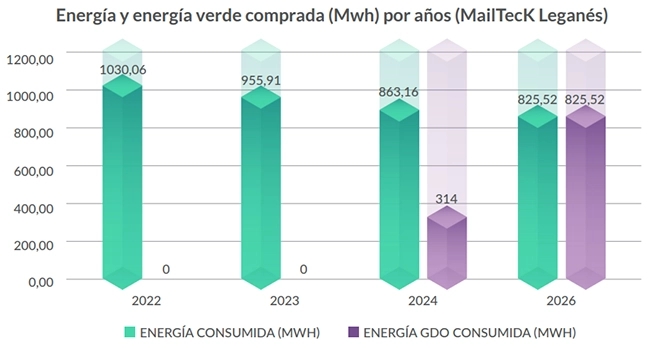
- In 2024, 36% of the electrical energy consumed at our plant came from renewable sources (GdO).
- By 2025, we have made the leap: 100% of the energy we consume is of renewable origin, significantly reducing our carbon footprint associated with electricity consumption.
- In addition, we are continuing to improve efficiency: consumption per 1,000 printed communications has been reduced from 6.3 kWh in 2024 to 5.3 kWh in 2025, a decline that has continued for several years.
Each campaign, invoice, policy or printed communication we produce incorporates a lower carbon footprint per unit, in line with the decarbonization requirements of the financial, insurance, energy and NGO sectors.
Paper supply with a smaller footprint and positive impact on forests
In 2024 we were already committed to using responsibly sourced paper. In 2025, we have gone further:
- We have completed the approval of critical paper suppliers, analyzing the carbon footprint per ton supplied, differentiated by supplier.
- 86% of the paper we buy already comes from FSC or PEFC certified sources, which guarantees responsible and traceable forest management.
This approach connects with one of the clearest ESG trends: the supply chain decarbonization strategy and the incorporation of environmental criteria in the purchase of materials and services.
Waste and circularity: maintaining and improving the Zero Waste standard
- In 2024, we achieved the maximum category of “Zero Waste” by recovering more than 90% of the waste generated.
- In 2025 , we will maintain this certification and improve our recovery percentages, with recycling and recovery processes that cover practically all the waste generated in our activity.
This brings our printing and physical communications business model in line with the circular economy, a regulatory and market priority both in the EU and in the sectors we serve.
S for Social: stable employment, reconciliation and security
In the social sphere, 2025 represents a further step in the professionalization and care of people:
- We maintain our commitment to stable and quality employment, with permanent contracts and covered by the applicable Collective Bargaining Agreements.
- We have obtained the Family Responsible Company (EFR) certification, which recognizes our commitment to work-life balance.
- Our performance in occupational risk prevention remains among the best in our sector, with accident rates and absenteeism due to professional contingencies well below the average.
For our clients, this translates into stable, qualified and expert teams, capable of ensuring service continuity and quality in critical legal, regulatory and commercial communication projects.
G for Governance: more ESG integration in the value chain
In 2025, we strengthened our governance and compliance system:
- The Supply Chain Code of Conduct is consolidated as a reference framework for employees and suppliers, integrating ESG criteria into day-to-day decisions.
- We have completed our CO₂ emissions inventory (Scopes 1, 2 and 3) and set 2024 as the base year, in line with international best practices.
- We maintain our public commitment to decarbonization through the SME Climate Hub initiative and have published our first Global Compact COP report in 2025.
This way of managing sustainability allows us to better accompany our customers in their own decarbonization plans, taxonomy and ESG reporting, providing reliable data on the impact on their supply chain.