



Table of Contents
- The evidentiary value of certified email in litigation and trials
- Main applications of certified email as valid electronic evidence in litigation and trials
- An example of the implementation of certified email as valid evidence in lawsuits and litigation: ADR proceedings.
- Frequently asked questions on how certified email affects the validity of electronic evidence in litigation and trials
Even the judicial sector is not immune to the digital transformation. Although it is a sector that is more reticent to change, it is impossible for it not to adapt to the impulse and boom of electronic communications. In fact, the authorities are beginning to legislate recognizing the evidentiary validity of these means and promoting their use, both in the EU and in Spain.
In this sense, certified email has played a leading role from the very beginning. We check it with a review of its implementation and influence.
These are the issues we focus on:
- Brief review of the qualities that make certified email a valid electronic evidence in legal proceedings.
- Contexts in which certified e-mails are most effective for their legal evidentiary value.
- ADR procedures, recognition of the role of certified email as electronic evidence in litigation and trials.
This guide summarizes how to send a certified email.
The evidentiary value of certified email in litigation and trials
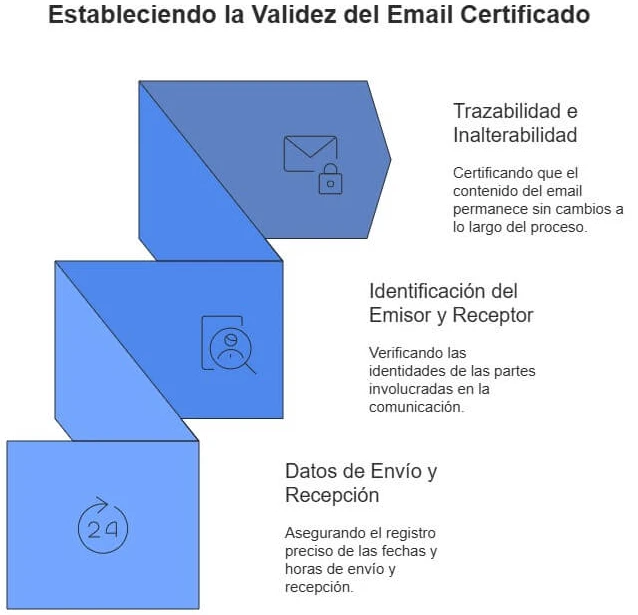
It is important to understand that a certified email is not just any email. Emails are valid as electronic evidence in judicial or mediation proceedings as long as they are certified. The key element is the presence of a Qualified Trust Service Provider who is authorized to verify that the legal requirements are met in order to have that trustworthiness:
- Sending and receiving data: the date and time the message was sent and received are accurately accredited. The certified email, in addition, allows to add the acknowledgement of receipt to confirm that the mail has been received and opened.
- Identification of the sender and receiver. Again, with the possibility of increasing this level of identification with tools such as electronic signatures, at different levels.
- Traceability of the process and unalterability of the content. It is certified that the communication has not been altered or modified at any time during the process, including its storage.
In addition, the issue of privacy and security of digital communications is essential, respecting the current regulations. We talk about eIDAS 2 and the RGPD, both from the EU and with demanding levels of data protection and digital identity. how certified email guarantees data protection.
Main applications of certified email as valid electronic evidence in litigation and trials
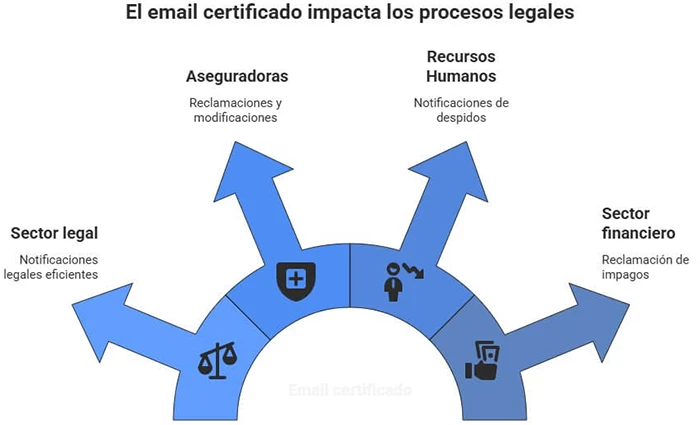
Certified e-mails can be considered reliable evidence in all types of legal disputes. However, there are some areas in which it stands out for its efficiency.
- In the legal sector and law firms: legal notifications, sending documents and contracts, management of claims or lawsuits. Also, it is interesting to use it in legal authorizations to third parties.
Here you can learn more about the importance of certified email in legal communications.
- Insurance companies: claims, modifications in policies and contracts or notification of indemnities.
Tips to implement certified email in insurance companies to guarantee the delivery and validity of documents. implementing certified email in insurance companies to guarantee the delivery and validity of documents.
- In the labor and Human Resources area: dismissal and sanction notifications, contract management, ERES or ERTES notifications.
- In the financial and economic sector: claiming unpaid bills and invoices, debt refinancing, credit concessions, contracting of financial products or registration/deregistration in delinquent registers.
It is interesting to read this analysis of the differences between certified email and other means of notification in terms of cost and efficiency.
An example of the implementation of certified email as valid evidence in lawsuits and litigation: ADR proceedings.
Finally, we look at a very significant example of the role of certified email in the modernization of Justice in Spain. Specifically, we highlight the ADR (Appropriate Means of Dispute Resolution) procedures included in the Organic Law 1/2025 on the Efficiency of Justice.
In a context in which, among other objectives, the aim is to unblock the collapse of the administration of Justice and to speed up the processes, the ADR mechanism is essential. In short, it establishes the obligation to arbitrate an attempt at mediation before resorting to the courts.
For what we are interested in at this moment, the certified email stands out as one of the means by which the communications of this previous mediation can be accredited. To the immediacy, affordability and simplicity of use of certified e-mails, we can add their full legal validity for these cases. And the fact is that they comply with the requirements demanded by this law, documentary accreditation of the date, reception and access to the content of the communication.
Certysign, the multichannel platform for certified communications that we offer you at MailComms Group. An exclusive, simple and user-friendly technological tool that is part of our quality and effective solutions. Contact us and we’ll talk about all the possibilities!
However, there are still discrepancies about the use of certified email. So far, the only means that has not been questioned by any court is the postal bureaufax. A good example of this is the method of notification of one of the most used ADRs, the Confidential Binding Offer.
Frequently asked questions on how certified email affects the validity of electronic evidence in litigation and trials
Are all digital media valid as electronic evidence in lawsuits and litigation?
Digital communications can be presented as evidence, but they can be challenged. What is reflected in the Civil Procedure Act (Article 162) is that “acts of communication between the parties may be carried out by electronic means that guarantee the authenticity of the communication and its content”.
This guarantee of data authenticity is what occurs with the certification process. And, therefore, the great difference between certified digital communications and that confers them full legal validity.
Is all certified email valid as electronic evidence in lawsuits and litigation?
In the case of certified e-mails, there is no doubt about their evidentiary validity. They are managed through a Qualified Trust Service Provider, which is responsible for verifying the unalterability of the date of sending, the content of the mail or the identity of the sender and the addressee.
Is certified email comparable to paper-based documentary evidence?
Not always. It is not always possible to equate a certified email with a postal bureaufax, it all depends on the technological means associated with each process and the level of evidence to be extracted.
The trend is to legislatively reinforce the evidentiary validity of certified electronic communications as a means of expediting judicial processes and contributing to sustainability.