



Table of Contents
One of the main differences between general and personalized promotional campaigns is their reflection in the audience response rate. Personalizing increases that response and that is a measurable advantage. Direct marketing automation allows a company to streamline that interaction while maintaining that effective one-to-one contact. A possibility that is open thanks to technological advances and that is easy to implement, as we have analyzed.
Learn more about our direct and promotional marketing service for companies.
This is the development we are following:
- A review of the role of personalization in direct marketing.
- The specific points where automation will improve the efficiency and customization of these actions.
- The technological tools that enable this automation.
Here you can remember what direct marketing is and its main strategies.
The concept of personalization in direct marketing
Personalized communications are the DNA of marketing campaigns in the 21st century. Companies need to attract attention and arouse curiosity in the public to differentiate themselves. But they also need to respond to their needs and improve the customer experience (CX).
Therefore, personalization should not be understood as simply managing many segmentation fields and using them to launch messages using certain personalized variables (personal data, product preferences, etc.). The success of these campaigns implies giving maximum value to the customer.
This concept of personalization described above should be reflected in the improvement of all phases of Brand-Customer communication, facilitating user reaction, with integrated and simplified processes. And this is where automation becomes an essential ally, because it optimizes resources and integrates processes, providing a real-time response.
It’s time to review the defining characteristics that define personalized marketing.
How direct marketing automation improves efficiency and personalization
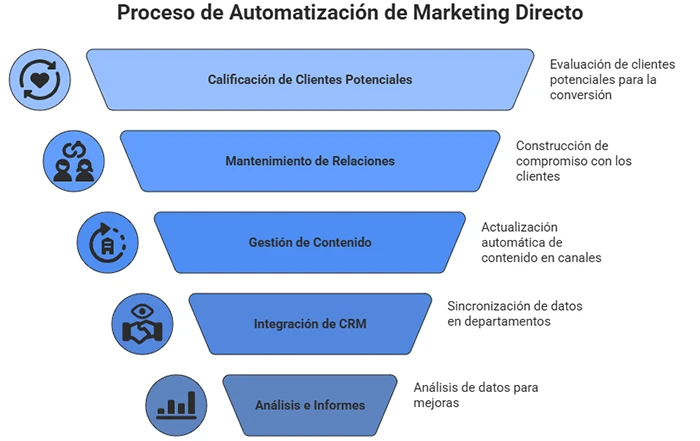
Direct marketing automation is nothing more than applying technology to integrate and streamline actions, which results in greater efficiency, both in improved results and in cost and time savings.
These are the main functions that are enhanced by marketing automation.
- Information gathering process(Lead Capture). This involves collecting contact information from users who might be interested in a product or service, with the aim of converting them into customers. Incentives are used, accompanied by some kind of form for them to leave their data.
- Establishing the scoring of potential customers. Automation allows this numerical scoring to be much faster, so that the marketing department has that all-important screening so important to achieve conversions.
- Maintaining relationships and tracking reactions(Lead Nurturing). Automation makes it easier for the customer to express his emotional commitment(engagement) and to follow up in real time, in order to react at the right time, which increases the probability of the purchase decision.
- Content management. Whenever content needs to be updated, that change is automatically pushed to all channels.
- CRM integration with the systems of all affected departments. The customer has a unified view of the company, which increases the probability of conversion. For the company, this synchronization facilitates an immediate reaction and reduces the risk of errors, since data entry is not done manually.
- Analysis and report. All data become part of a database, where a real-time analysis is performed. Thus, it is possible to have updated reports to improve the possible deficiencies detected.
Technology tools to implement direct marketing automation
It is clear that direct marketing automation requires the incorporation of a certain technology to be able to manage all the actions described above. Fortunately, these tools are compatible with your company’s IT systems and equipment, so you won’t have to invest in replacing equipment.
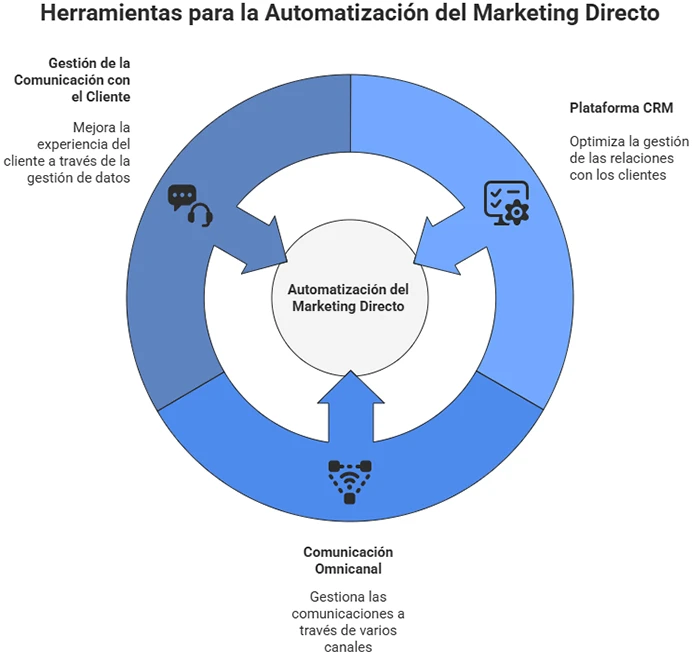
From the different possibilities, as experts in personalized omnichannel communication, from MailComms Group we consider that these are the advanced automation tools that your company needs to increase efficiency and personalization:
- A customer relationship management platform to optimize automation, this CRM should be able to integrate with other applications (sales, marketing or customer service) and generate a 360-degree view of the customer. Salesforce, a benchmark in communications integration.
- An omnichannel communication platform that allows you to design, segment, manage and store communications, both physical and digital channels. This way, your company can automate the analysis of their behavior and improve data and strategies, while maintaining their channel preferences. Communicalia, a SaaS approach to omnichannel communications.
- CCM(Customer Communications Management) to optimize the customer experience. In this sense, in addition to multichannel, it is important to enable the integration of data analysis in customer itineraries.
At MailComms Group we have been leading omnichannel communication solutions for 30 years. Contact us at and discover how we can facilitate the digital transformation of your company in the field of automation of your direct marketing campaigns.
Frequently asked questions about direct marketing automation and how it improves efficiency and personalization
In which processes does automation improve the effectiveness of direct marketing campaigns?
Ideally, it should be incorporated into all phases and actions, from information gathering, message delivery, customer follow-up and analysis of results.
Does the company's software need to be replaced or changed to include direct marketing automation technology?
It depends on the supplier. In the case of MailComms Group, all our technological tools are compatible with a company’s systems (ERP, CRM, ECM). In addition, we use SaaS (Software as a Service) environment so that a secure web environment can be accessed from any device.
Does the automation of direct marketing campaigns comply with data protection legislation?
Ensuring compliance is an important aspect, so make sure and work with your platform provider to bring your processes into compliance.